Prenatal Rejection: Early wounds in psyche and how to see it in the natal chart
Prenatal Rejection: The Earliest Wound in Psyche and Birth Chart
What depth psychology and esoteric astrology reveal about feeling unwanted before we are born, and how that wound can be healed.
By Christos Archos
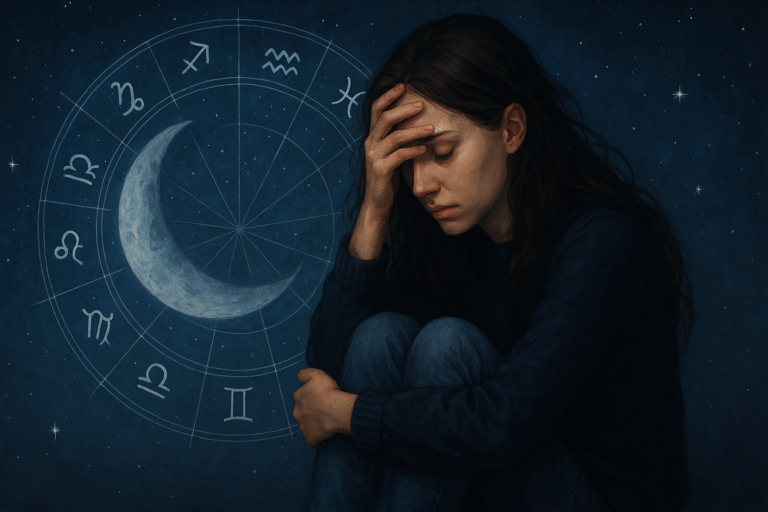
Some people move through life with a quiet conviction that they were never quite meant to be here. It rarely announces itself directly. It surfaces instead as a low hum of not-belonging, a reflex of bracing for abandonment, a difficulty believing that love, once given, will actually stay. Often there is no event to point to and no memory that explains it. That is precisely the puzzle: the wound seems to predate the biography.
Depth psychology and esoteric astrology converge on a striking possibility. The earliest chapter of our emotional life may be written before birth, in the months we spent in the womb, attuned at a level beneath thought to a single unspoken question: was I wanted?
This is an exploration of what I call prenatal rejection, the clinical and esoteric term being intrauterine rejection. It is not a verdict and not a diagnosis. It is a lens, and for some readers it may quietly explain a great deal.
The Psychology of Prenatal Rejection
What it means
Prenatal rejection describes a situation in which the unborn child registers, on a bodily or unconscious level, that it is not desired by its mother. This most often arises around an unwanted pregnancy or during periods of intense maternal stress during gestation. What exactly an unborn child perceives in the womb is still genuinely debated, ranging from states of calm and stress to something as subtle as the felt sense of being unwelcome. Yet the evidence keeps accumulating that such early experiences can leave a deep imprint on the psyche.
The psychoanalytic view
From a psychoanalytic standpoint, the prenatal and infant stages are treated as decisive for the shaping of the unconscious. As early as 1924, Otto Rank argued that birth itself is traumatic for the infant, his famous trauma of birth. The analyst Nandor Fodor later extended the idea backwards, examining the experiences before birth, the psychic preparation of the child within the womb.
In an unwanted pregnancy, a mother may live through powerful conflict, denial, or rejection toward the fetus, and psychoanalytic theory holds that something of this is transmitted. The child takes in, or introjects, that negative stance as a primary negative nucleus. Later in life the person may carry an unconscious fear of abandonment, or a sense of being without worth, that seems to reach back to the very beginning. Object-relations theorists describe it this way: when the mother rejects the infant, the infant tends to form an internal object, an inner mother, that is cold or punishing. Growing up, such a person may struggle with trust and self-esteem, almost as if always expecting rejection from the people who matter most.
The trauma view
Contemporary trauma research shows that prenatal stress can shape the developing brain and nervous system of the fetus. Acute maternal stress, especially the feeling of not wanting the child, is accompanied by elevated levels of cortisol and other stress hormones in the bloodstream. These hormones cross the placenta and effectively program the developing brain to be more reactive to stress. The fetus, in other words, receives biochemical signals consistent with a state of danger.
In extreme cases, where a mother is seriously considering termination or emotionally rejecting the pregnancy, the fetus may register that rejection as something close to a threat to life. Trauma therapists report that many people with unexplained anxiety or a fierce fear of abandonment show signs of a wound that locates, in time, in the mother’s belly. In body-oriented work these traces are not conscious memories but are inscribed in the body and the autonomic nervous system. The body remembers the experience of not being wanted, and reacts to later situations that, on an unconscious level, resemble that original rejection.
The developmental view
The consequences continue after birth, shaping psychosocial development. Mothers who carried a pregnancy they did not want often face real difficulty in caregiving: a more authoritarian or distant parenting style, more anxiety and stress in the postpartum period. The practical result is that the infant may not receive the warm, consistent responsiveness it needs. Attachment theory, as developed by John Bowlby and Mary Ainsworth, emphasizes that infants build secure attachment when the caregiver is emotionally available and responsive. When the mother is cold, reluctant, or depressed, common in unwanted pregnancies, the child may instead develop an insecure attachment. This shows up either as anxious attachment, where the child lives in fear of being abandoned, clings, and dreads separation, or as avoidant attachment, where the child learns to have no needs, withdraws emotionally, and avoids closeness.
One of the most careful long-term investigations of this question is the Prague Study, led over several decades by Zdeněk Matějček, Zdeněk Dytrych, Vratislav Schüller and Henry P. David. It followed 220 children born in the early 1960s to women who had twice been refused abortion for the same pregnancy, alongside 220 carefully matched controls, and reassessed them at ages nine, fourteen to sixteen, the early twenties, thirty, and thirty-five. The differences were never dramatic, and they narrowed over time, but across the decades they leaned consistently in one direction: those born of an unwanted pregnancy tended, on average, toward somewhat poorer psychosocial adjustment and mental well-being in adulthood. The finding is sobering and, at the same time, reassuring in its modesty: a difficult beginning tilts the odds, but it does not dictate the outcome.
The experiential view
Experiential schools of psychotherapy focus on how the earliest experiences become a lived reality carried through an entire life. The prenatal experience of rejection, even with no conscious memory attached, can later be felt as a gap or rupture in contact with the maternal energy; people who carry it often describe feeling as though they do not belong anywhere, or that something is missing inside. Approaches from Primal Therapy to contemporary somatic trauma work try to bring these pre-verbal experiences to the surface. Through regression, deep relaxation, or guided imagery, a person can reconnect with the wounded infant within and give it the acceptance and love that were once withheld, so that the wound gradually closes and the repeating cycle of rejection loses its grip.
How it echoes through a life
Taken together, prenatal rejection can touch a person on several levels:
- Infancy and childhood: insecure attachment to the mother, possible delays in cognitive or emotional skills from reduced positive interaction, heightened irritability, and even physical correlates such as lower birth weight.
- Adolescence: greater vulnerability to depression, withdrawal, or risk-taking. The absence of a secure family base can push a teenager toward either rebellion or acute anxiety.
- Adult life: difficulty with intimacy, fear of abandonment or trouble trusting, chronically low self-esteem, and a pervasive sense of I am not enough that can feed impostor feelings or a constant hunger for reassurance.
A signal, not a sentence
It must be said clearly: a child’s fate is not inevitably written by the prenatal experience. A great deal depends on what comes after. A mother who first felt rejection but later embraced her child with love, or a devoted grandmother or father who provided steady care, can compensate to a large degree for the original wound. What matters most is awareness. Recognizing the possibility of a prenatal wound is meaningful precisely because it can explain otherwise inexplicable feelings and relational patterns, and because it opens the door to healing.
Astrological Indications in the Natal and Prenatal Chart
In esoteric astrology, as developed by Alice Bailey, the birth chart is read as a road map of the soul, showing the lessons and challenges a person has chosen to meet in this incarnation. On this view, the soul selects the parents, the environment, and the conditions of birth that will offer the experiences it needs for growth. A wound such as prenatal rejection can therefore be understood as part of the curriculum the soul took on: difficult, yes, but in service of maturation.
Important. Only an experienced professional astrologer can draw conclusions about a real chart. The aspects described below are indicative. Having them does not mean a person has necessarily experienced prenatal rejection. These are symbols to be read in context, never labels to be applied.
In practice, astrologers look for symbols in the chart that mirror such early wounds. The primary indicator of maternal energy is the Moon. The Moon represents the mother, our emotional foundation, and our unconscious memories, including those from the earliest moments of life. In the esoteric teaching the Moon is even called the Mother of all Forms, signifying that it is through her that souls incarnate into matter; she carries heredity and the past. A wounded Moon, one receiving hard aspects from challenging planets, often points to wounds connected with the mother or with early childhood.
Moon and Saturn: the cold or absent embrace
The conjunction, square, or opposition of Moon and Saturn is a classic marker of emotional deprivation or coldness from the mother. Saturn is the planet of limitation and karma, and when it embraces the Moon it suggests the person likely felt they did not receive warmth and acceptance from the maternal figure. Psychologically, this aspect corresponds to feelings of rejection, disappointment, and the suppression of the child’s needs. Where the Moon meets Saturn, an astrologer will wonder whether, during gestation or the earliest years, the mother was emotionally distant, overly severe, or herself suffering from depression or stress that prevented her from offering tenderness.
Moon and Pluto: survival and intensity
Pluto governs the primal forces of transformation, death, and rebirth. Hard aspects to the Moon suggest a relationship with the mother marked by intensity, trauma, or crisis. Moon and Pluto can symbolize a dynamic in which the infant felt its emotional, or even physical, survival was threatened. The mother may have lived through a very dark period during the pregnancy, or the bond after birth may have carried controlling or power-laden elements, since Pluto is bound up with dynamics of power. People with this contact often describe a deeply rooted fear of abandonment or betrayal, alongside emotions that occasionally overwhelm them for no apparent reason, hinting at a buried traumatic root.
Moon and Chiron: the inherited ache
Chiron is the wounded healer, the symbol of a deep psychic wound that asks to be healed. A hard aspect between Moon and Chiron reveals a primal wound in the mother and child relationship. People with this contact often describe sensing, as they grew, that something was missing in the love they received, as though the mother could not quite give full tenderness, without their understanding why. It fits situations where the mother, during or after the pregnancy, was carrying her own deep wounds, postpartum depression, or guilt over not initially wanting the child. The child inherits a sense of woundedness. The redemptive note is that those with Moon and Chiron, once they recognize their own wound, often have a gift for becoming healers themselves, turning pain into wisdom.
Other signatures
- Moon and Uranus (hard aspects): a possible abrupt break in the bond with the mother, such as separation immediately after birth or time in an incubator. Uranus brings sudden ruptures and distance.
- Moon and Neptune (hard aspects): a mother who is absent or lost in her own world, perhaps through depression, substances, or another form of escape. The child experiences a dissolution of the maternal presence and may turn toward flight or fantasy to cope with the emptiness.
- Planets in the 4th house: Saturn, Pluto, or Chiron in the 4th house or near the IC often accompany difficult family environments. The 4th house symbolizes the womb, literally and metaphorically, and the foundations of the psyche.
- Moon in detriment or fall: the Moon in Capricorn or Scorpio is traditionally linked with difficulty expressing emotion, and can reflect a mother who could not emotionally nourish the child. On their own these placements are not enough, but combined with the aspects above they strengthen the picture.
- Black Moon Lilith: when emphasized in the chart, conjunct the lights or on the angles, Lilith, the symbolic point of the dark feminine, can indicate a history of rejection or wounding of the feminine. In myth Lilith was the cast-out feminine; astrologically, a strong Lilith may suggest the Mother archetype was shadowed by rejection or abandonment in the person’s story.
The prenatal chart
Beyond the natal chart, cast for the moment of birth, esoteric and karmic astrology sometimes also examines a prenatal chart. This may be the chart of conception, where it is known or can be rectified, or more often the chart of a significant prenatal moment, such as the last new Moon or eclipse before birth. The logic is that these charts capture the energetic imprint that prevailed in the womb. Bailey’s teaching, transmitted through the figure she called Djwhal Khul, holds that the soul fully enters the body of the fetus around the seventh month of gestation, so an astrologer might cast the chart of that moment to read the energetic conditions surrounding the soul. Typical symbols of rejection in a prenatal chart parallel those of the natal one: an eclipse, a powerful karmic event, involving the Moon with Saturn or Pluto could mark the trauma. Or, if in a conception chart the Ascendant, which in esoteric astrology relates to the soul’s purpose, sits in a hard aspect to Chiron, one might infer that the soul chose a life in which it would meet and heal a primal wound of rejection.
An illustrative reading
To make this concrete, consider an illustrative case; call him Philippos. His chart shows a Moon and Saturn conjunction in the 4th house and Chiron on the Ascendant. Seeing this, an astrologer might gently ask: Was your relationship with your mother difficult from the very start? Do you carry, deep down, a fear of being abandoned? The symbols suggest that very early there was an experience in which life and death hung in balance: the Moon and 4th house, the foundations of life, met by a restrictive Saturn and a wounding Chiron. This fits a story of prenatal rejection, where a mother seriously considered ending the pregnancy but ultimately did not. That she chose to continue is mirrored too, in a Midheaven in Taurus, patience and the search for security, with Venus, the ruler of Taurus, conjunct it, reflecting her eventual effort to find stability and connect with her child.
Where psychology and astrology meet
An astrological signature does not cause an event; it symbolizes the corresponding experience. Astrologers who work synthetically, both psychologically and esoterically, read such aspects as a map for healing. If a possible prenatal wound is identified through the chart, it can help a person understand why they feel as they do, and move them toward methods that reach the deep layers, hypnotherapy, energy work, or trauma-focused psychotherapy, in order to release the primal anxiety.
In the esoteric teaching, the ultimate aim is for the soul to transcend the limitations of the past. The Moon symbolizes the past and the matter that holds spirit in old patterns. It is no accident that Bailey described the Moon as a dead form, an obsolete vehicle that must one day disappear, meaning that we are called to outgrow the old wounds and imprints we carry. By recognizing and healing the wound of prenatal rejection, a person loosens the karmic chains, symbolized by the Moon, and allows the higher self to express itself with more love and more freedom.
If any of this resonates with your own story, treat it as an invitation rather than a conclusion. A wound that began before memory can still be met, understood, and tended, and that work is best done with a qualified professional who can walk beside you. The chart does not sentence us. At its best, it simply shows us where the healing wants to begin.
Read your own chart with these themes in mind
A natal consultation can explore, with care, what your chart may be saying about your earliest emotional foundations.
Book a consultation